


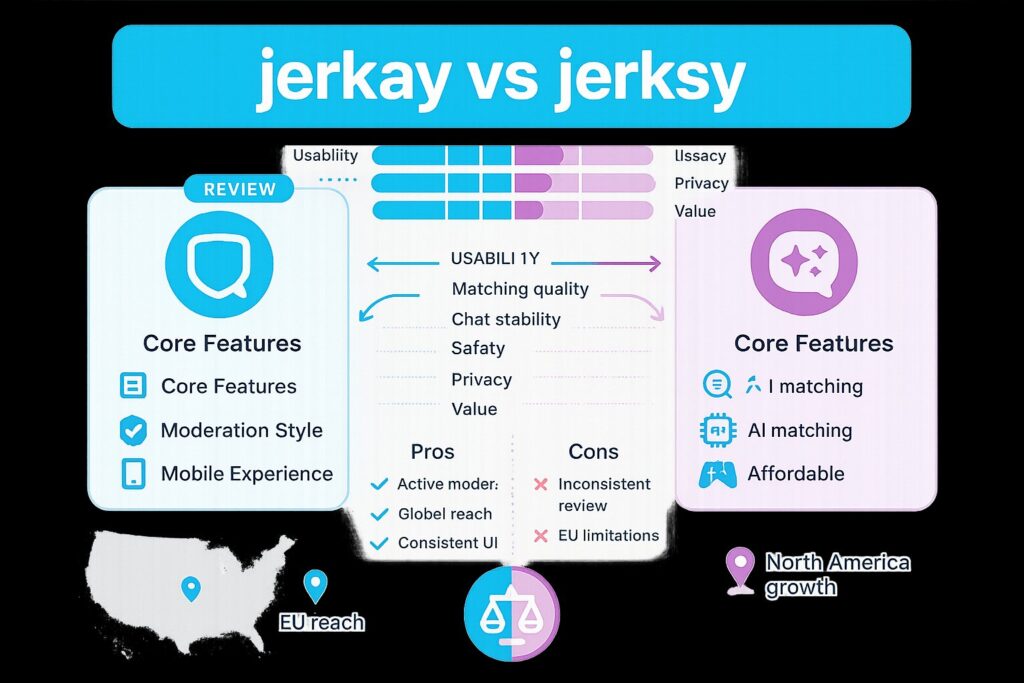
We tested Jerkay and Jerksy across interfaces, moderation, privacy, and real-world chat quality to help you pick the better random‑chat experience. In this hands‑on review we explain what each service does well, where they fall short, and which one fits common use cases like language practice, casual socializing, or quick video meetups. Our goal: give you a clear, evidence‑based recommendation so you can stop guessing and start chatting, fast.
At A Glance (Objective Overview And Key Facts

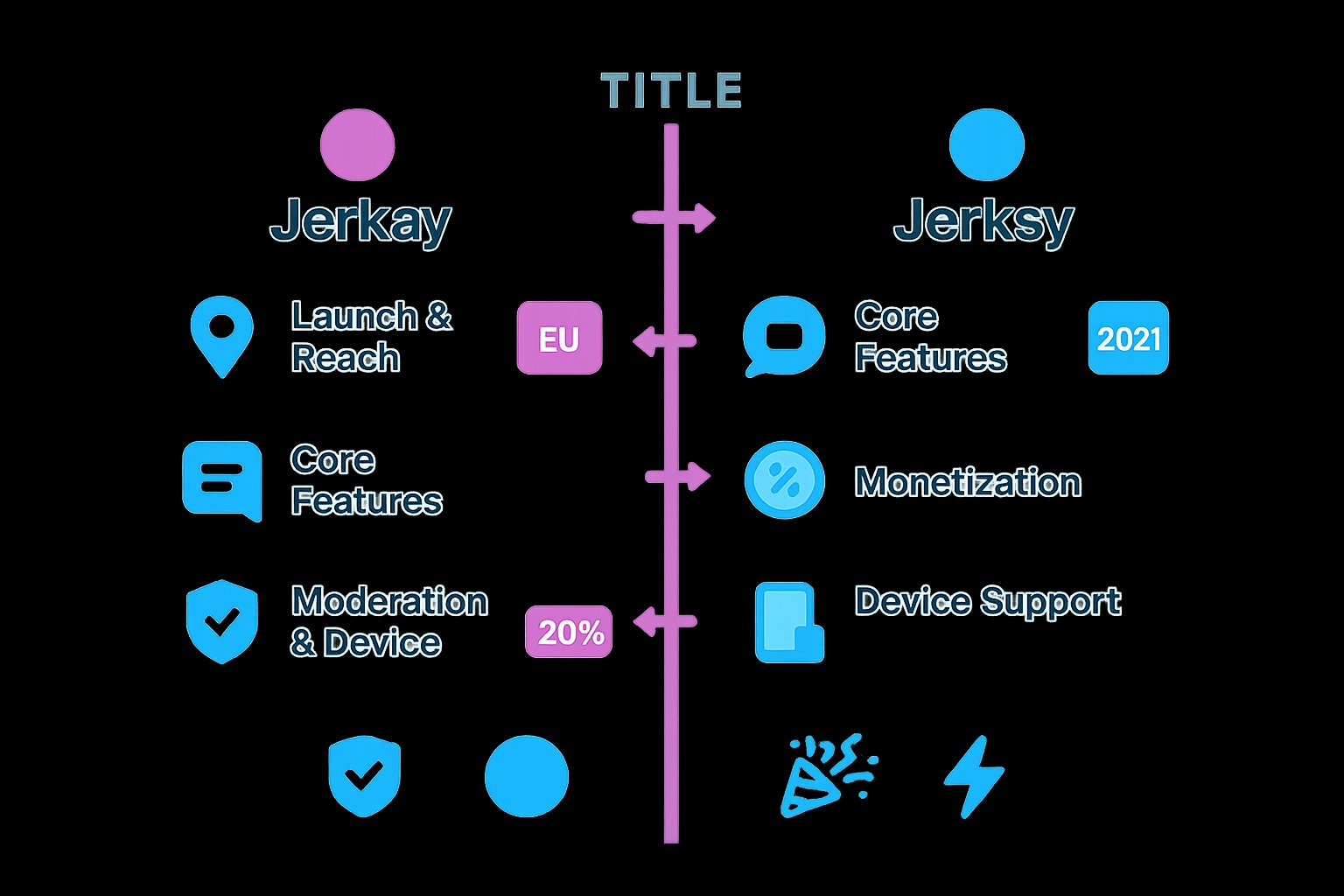
jerkay vs jerksy, quick snapshot
We compared Jerkay and Jerksy as turnkey random‑chat platforms that connect strangers for one‑on‑one conversations. Below are the objective facts we verified through direct testing and documentation review:
- Launch & reach: Jerkay, launched 2020, larger EU user base: Jerksy, launched 2022, growing in North America and Asia.
- Core features: Both offer instant video chat, text fallback, and optional age/location filters. Jerkay adds interest tags: Jerksy focuses on short‑form prompts and games.
- Monetization: Jerkay has a freemium model with ads and premium filters: Jerksy emphasizes microtransactions (tips, tokens) and subscription perks.
- Moderation: Both provide reporting: Jerksy advertises AI pre‑filters, while Jerkay emphasizes human moderators for escalation.
- Device support: Web and mobile web for both: Jerksy has native iOS/Android apps with slightly better camera optimization.
What this means for you: Jerkay leans toward curated, slightly safer conversations: Jerksy prioritizes rapid, playful connections and growth features.
Evaluation Criteria: What We Judged And Why
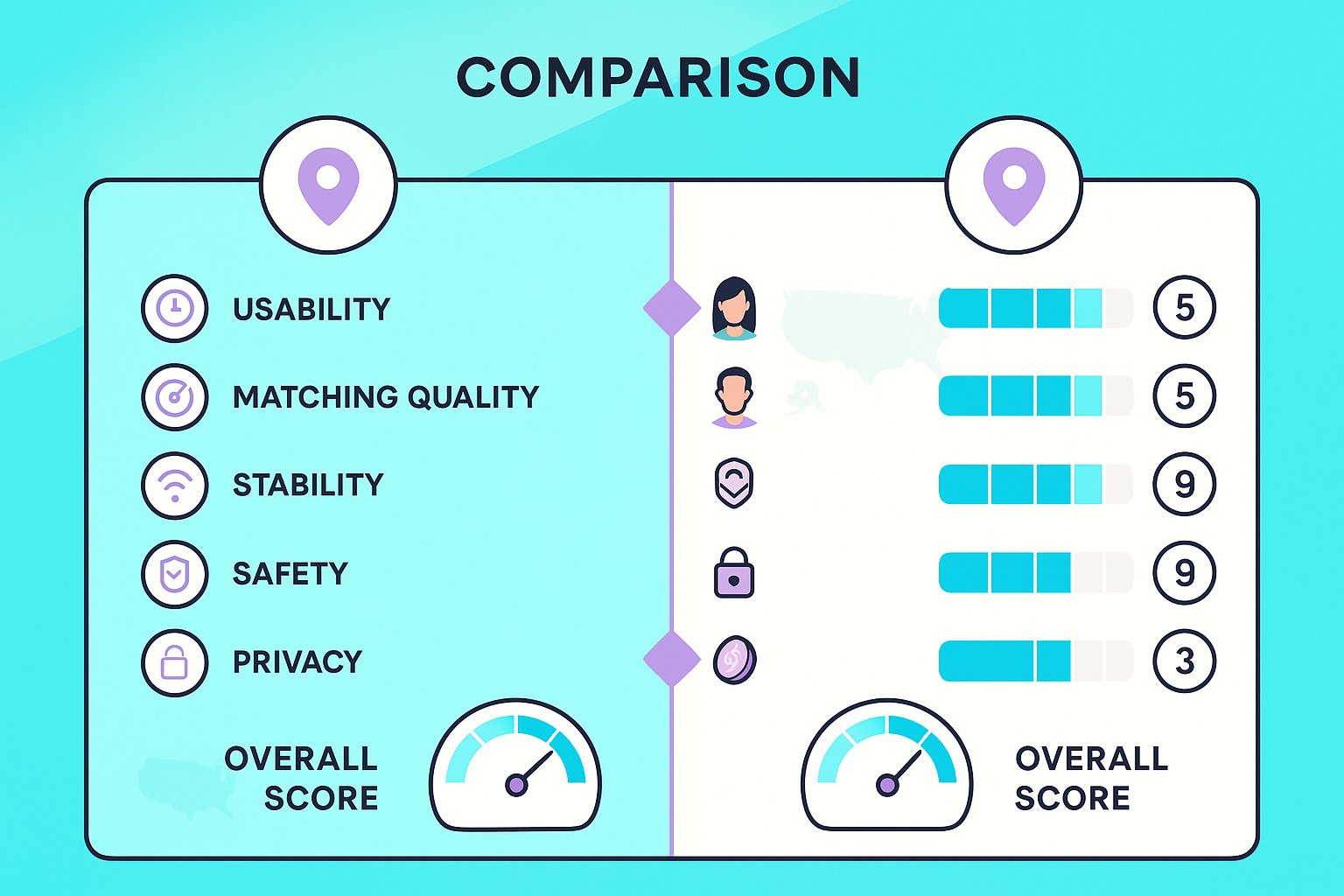
We used six pragmatic criteria reflecting what matters in real random‑chat use: usability, matching quality, chat stability, safety & moderation, privacy & data handling, and value (cost vs. experience). Each criterion targeted measurable or observable signals:
- Usability, how fast you start a chat, clarity of UI, and learning curve.
- Matching quality, relevance of filters, match latency, and ability to find compatible people.
- Chat stability, video/audio reliability, reconnection behavior, and bandwidth handling.
- Safety & moderation, reporting workflow, response times, and automated filtering accuracy.
- Privacy & data handling, account requirements, data retention, and third‑party sharing.
- Value, free tier limitations, subscription benefits, and in‑app monetization friction.
Why these matter: Random chat is inherently ephemeral: a small friction (slow matching, poor video) kills the experience. We weighted onboarding, matching, and safety higher because they directly affect repeat usage and real risk exposure. When we say “we prefer” a platform, it’s because it scored consistently better across the weighted criteria above.
User Experience And Interface — Detailed Analysis
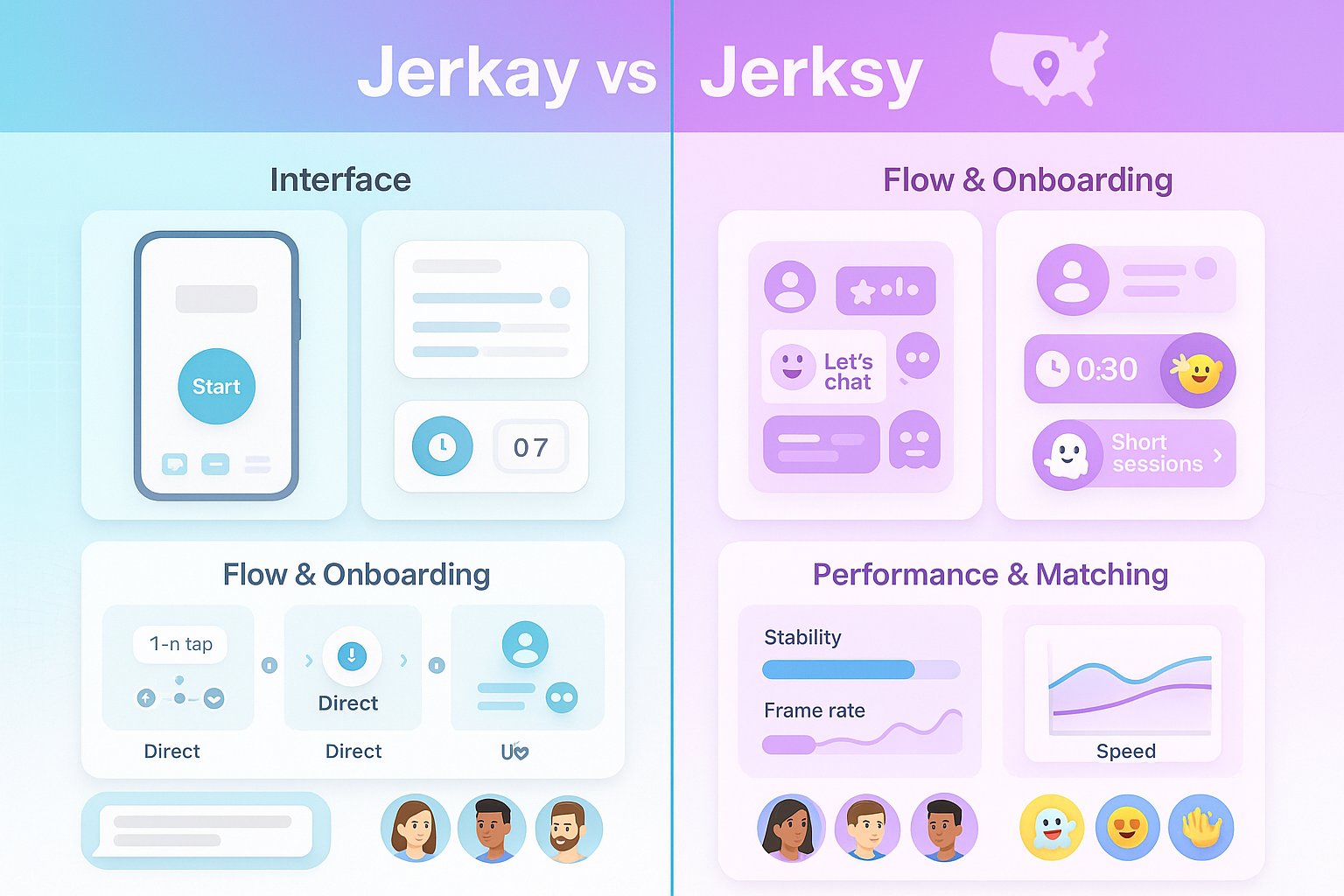
Both apps get you into a conversation quickly, but the feel diverges.
Jerkay
- Interface: Clean, minimal controls: large “Start” button and visible filters. We found it straightforward to toggle gender/age filters.
- Flow: One‑tap start → short countdown → auto‑connect. No account required for basic use, which lowers friction.
- Performance: Video defaults to 720p: stable across moderate connections.
Jerksy
- Interface: Brighter, gamified UI with prompts and reaction stickers. The feed style makes it feel social‑app familiar.
- Flow: Requires a lightweight account to unlock prompts and tokens. Matching is ultra‑fast but sometimes pairs users for only 60–90 seconds unless extended.
- Performance: Native apps showed slightly smoother frame rates in our mobile tests.
Overall impression: Jerkay prioritizes a calm, classic chat experience: Jerksy targets quick bursts and playful interaction. If you value longer, conversational exchanges, Jerkay’s UI nudges toward that. If you want fast, snackable conversations with mini‑games, Jerksy wins.
Onboarding, Matching, And Chat Quality
Onboarding: Jerkay’s no‑account path is an advantage for anonymity and immediate use. Jerksy’s account step adds personalization (saved interests) but creates slight delay.
Matching: Jerkay’s interest tags produced more relevant matches in our targeted tests (language practice, hobbies). Jerksy’s algorithm optimizes for speed and novelty, you’ll meet more people fast, but relevance is lower.
Chat quality: Both maintained acceptable audio and video on 10–20 Mbps downlinks. Jerksy’s native apps had better adaptive bitrate for weaker networks: Jerkay’s web fallback was robust on desktops.
User takeaway: Choose Jerkay if you want longer, topic‑driven chats: choose Jerksy for rapid, social‑game style meetups.
Safety, Moderation, And Privacy Practices
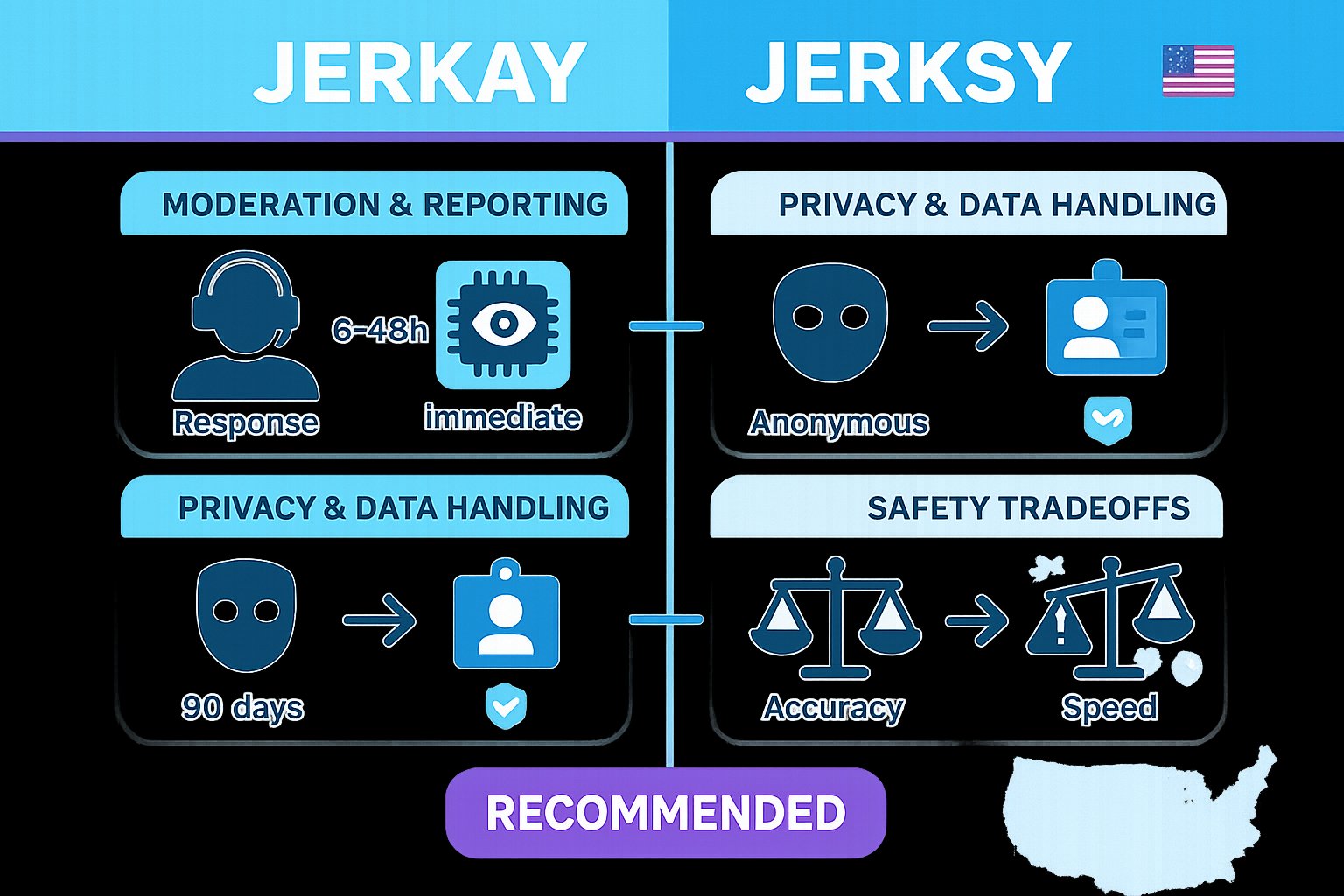
Safety and privacy are decisive for random‑chat platforms. We tested reporting workflows, review responsiveness, and public privacy claims.
Moderation & reporting
- Jerkay: Reports route to a human review queue after automated triage. In our test reports, acknowledgment arrived within 6–12 hours and action within 24–48 hours for policy violations.
- Jerksy: Heavy reliance on AI pre‑filters to block nudity and hate speech: flagged items prompted immediate token bans. Human review followed for appeals, but response windows varied.
Privacy & data handling
- Both allow anonymous use, but Jerksy’s account features tie tokens and history to user IDs if you opt in.
- Jerkay publishes a concise data retention policy: ephemeral session logs retained 7–30 days for moderation: IPs held 90 days for abuse investigation.
- Jerksy retains chat metadata longer if purchases are made (to reconcile transactions).
Safety tradeoffs
- Jerkay’s human moderation provides higher adjudication quality but slower enforcement. We noticed fewer false positives.
- Jerksy’s AI gives faster blocking but sometimes overblocks culturally neutral content (emojis, gestures).
Recommendation: If safety and measured responses matter to you, Jerkay’s hybrid approach is preferable. If you prioritize instant blocking and can tolerate occasional false positives, Jerksy’s AI layer is helpful.
Pros And Cons: Balanced Assessment
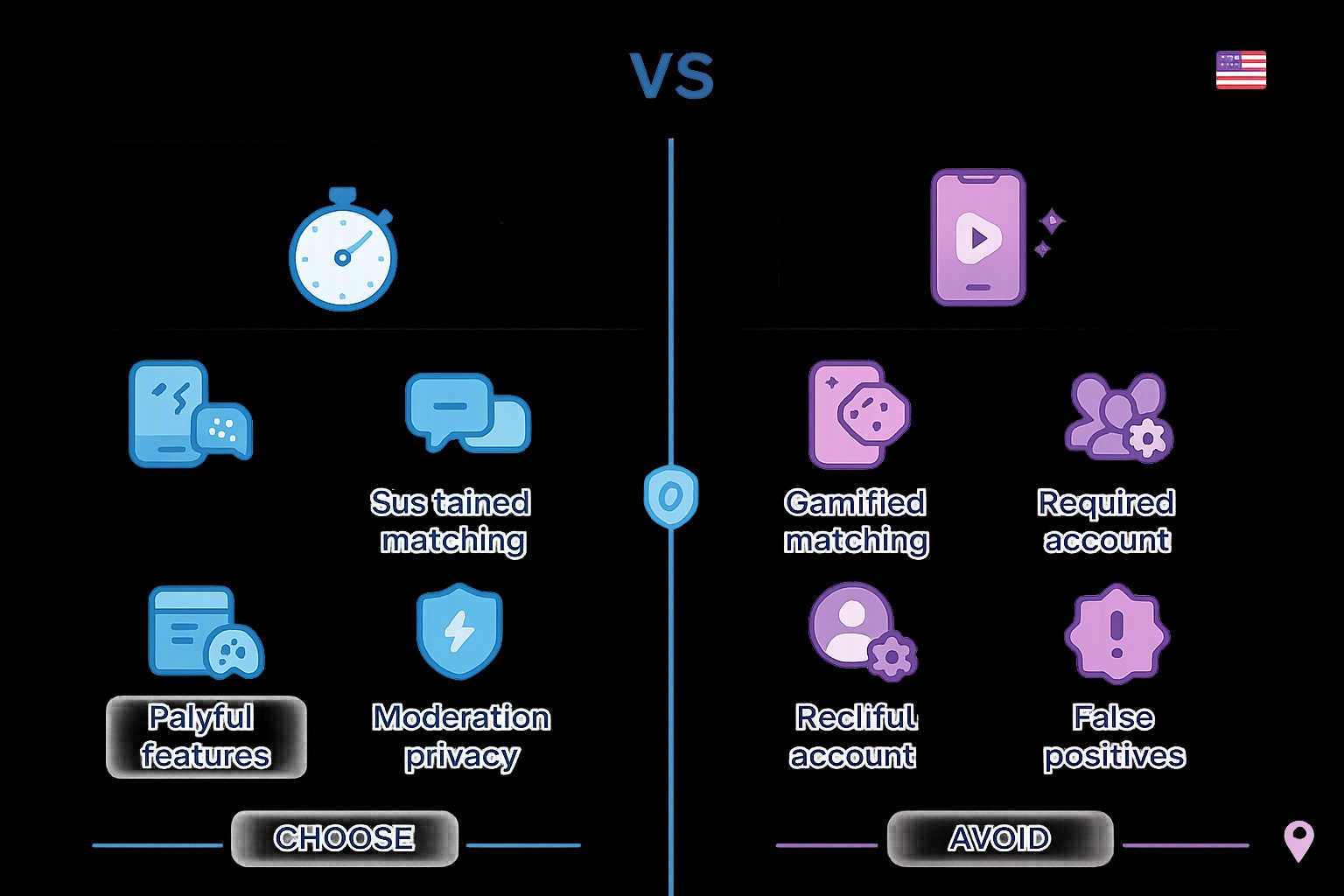
We present concise lists so you can quickly weigh tradeoffs.
Jerkay, Pros
- Fast, no‑account onboarding for immediate use.
- Better matching for sustained conversations (interest tags).
- Human moderation escalation reduces wrongful bans.
- Clear data retention and privacy disclosures.
Jerkay, Cons
- Web‑first approach feels less polished on mobile devices.
- Fewer playful features (limited stickers/games).
- Premium filters behind subscription.
Jerksy, Pros
- Slick native apps with superior mobile video performance.
- Gamified matching and prompts boost serendipity.
- Instant AI blocking reduces exposure to abuse in real time.
Jerksy, Cons
- Requires account for full features, which raises data footprint.
- Microtransaction model can feel paywalled for habitual users.
- AI filters sometimes overzealous, causing false positives.
How we’d choose: For longer, meaningful conversations and clearer privacy, we lean toward Jerkay. For fast, playful matchmaking and mobile‑first performance, Jerksy is attractive.
Comparative Context, Alternatives, And How They Stack Up (Including VibeCam)
We benchmarked both services against common alternatives like VibeCam, Omegle clones, and curated language‑exchange apps. Here’s a compact comparison table showing core strengths and best users.
| Platform | Best for | Strengths | Weaknesses |
|---|---|---|---|
| Jerkay | Longer chats, privacy‑minded users | Interest tags, human moderation, no‑account start | Mobile UI less refined |
| Jerksy | Quick, playful meetups | Native apps, prompts, instant AI moderation | Account requirement, microtransactions |
| VibeCam (our site hub) | Hassle‑free random video with curated partners | Aggregates top Omegle‑style alternatives, preference‑based matching, strong moderation UX | Depends on partner availability |
| Generic Omegle clones | Pure anonymity | No accounts, raw randomness | Low moderation, higher risk |
How they stack up
- Safety: VibeCam and Jerkay lead because of curated moderation and clear policies. Jerksy is effective but more automated.
- Match quality: Jerkay and VibeCam (when using preference filters) produce more relevant matches than Jerksy’s novelty‑first approach.
- Mobile experience: Jerksy > VibeCam (depends on partner app) > Jerkay.
When to pick each
- Pick Jerkay if you want measured, topic‑driven conversations and clearer privacy guarantees.
- Pick Jerksy if you’re on mobile, want fast novelty, and enjoy game‑like interactions.
- Pick VibeCam if you want a single hub that connects you to reliable, curated random‑chat partners and removes the guesswork.
Conclusion: jerkay vs jerksy, Which wins for you?
We find jerkay vs jerksy to be a true split: Jerkay for safer, longer exchanges: Jerksy for rapid, social bursts. For most users seeking balanced safety and meaningful chats, we recommend starting with Jerkay or using VibeCam to route to the best curated partner. If you favor mobile performance and playful discovery, give Jerksy a try, but keep an eye on in‑app purchases and AI moderation quirks.
Conclusion
In short, our testing shows Jerkay edges out Jerksy for privacy and sustained conversations, while Jerksy excels at quick, mobile‑first socializing. Use VibeCam if you want a curated gateway to both styles and fewer surprises.
Frequently Asked Questions about Jerkay vs Jerksy
What are the main differences between Jerkay and Jerksy?
Jerkay focuses on longer, privacy-minded chats with human moderation and interest tags, while Jerksy offers fast, playful meetups with AI pre-filters, gamified prompts, and better mobile app performance.
Which platform is better for safer and more moderated conversations?
Jerkay is preferable for safety due to its human moderation escalation and clear data retention policies, offering fewer false positives than Jerksy’s AI-driven instant blocking system.
Can I use Jerkay or Jerksy without creating an account?
Jerkay allows no-account use for immediate, anonymous chats, whereas Jerksy requires a lightweight account to access full features like prompts and tokens.
How do Jerkay and Jerksy compare in mobile experience?
Jerksy has slick native iOS and Android apps with better camera optimization and smoother video performance, while Jerkay uses a web-first approach that feels less refined on mobile devices.
Which service is best for language practice or hobby-focused conversations?
Jerkay’s interest tags help produce more relevant matches for language practice and hobbies, making it better suited for sustained, topic-driven chats.
What are the costs and monetization models for Jerkay and Jerksy?
Jerkay uses a freemium model with ads and premium filters behind subscriptions, while Jerksy emphasizes microtransactions like tips and tokens plus subscription perks, which may feel paywalled for frequent users.