


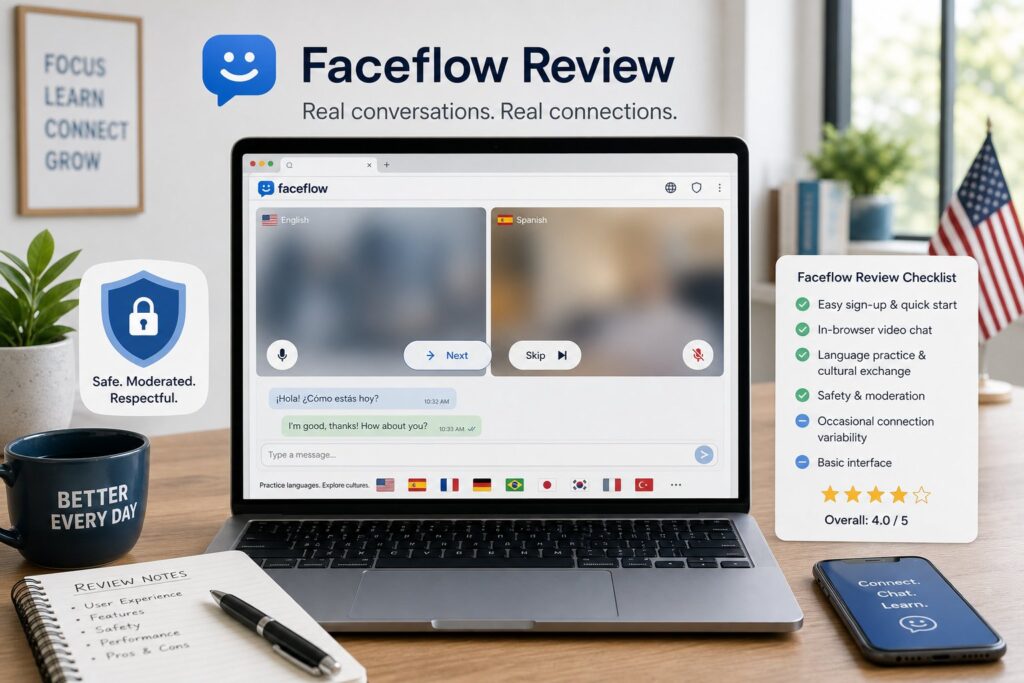
At A Glance: What FaceFlow Is, Who It’s For, And Key Features


FaceFlow is a browser-based random video chat and chat room platform where you can meet strangers instantly. Think: less “polished social app,” more “drop in and start talking.” It’s best for adults who want casual conversations, quick social hits, and especially folks using chats as a low-pressure way to practice speaking.
Who FaceFlow is for
- People who want instant random video chats without building a profile
- Language learners who want real-time conversation reps
- Travelers / culture nerds who like meeting people globally
- Anyone looking for Omegle-style spontaneity (with the usual caveats)
Key features (what you’ll actually notice)
- Random video chat (one-on-one style)
- Public chat rooms (group conversations)
- Basic text chat alongside video
- Simple on-site controls (next/skip, mute, etc.)
- Runs in a web browser (no required app install)
If you’re expecting a sleek, modern matching system with deep filters, FaceFlow isn’t that. It’s more “jump in and see who’s there.”
How We Evaluated FaceFlow: Criteria For Safety, Match Quality, And Ease Of Use

For this FaceFlow review, we focused on the stuff that actually makes or breaks a random chat site in real life, especially if you’re here for language practice and not chaos.
Our evaluation checklist
- Safety basics: reporting tools, block options, privacy controls, and how easy it is to leave/skip
- Moderation signals: visible rules, friction against abuse, and how quickly you can react to bad behavior
- Match quality: how often you get real conversations vs dead mics, bots, or “instant skip” users
- Ease of use: time-to-first-chat, permissions prompts, and whether the interface fights you
- Video stability: lag, audio sync, and whether controls work reliably in-browser
We’re also realistic: random video chat platforms are inherently messy. So we judge FaceFlow against its category, not against a curated dating app or a paid tutoring platform.
Setup And First-Time Experience: Sign-Up, Permissions, And Time-To-First-Chat

Getting started on FaceFlow is pretty straightforward. You typically land on the site, pick a mode (random chat vs rooms), and you’re basically one permission prompt away from talking.
Sign-up: In many cases, you can explore without building a full profile, which is a win for speed. If you do create an account, it’s more about identity-lite continuity than building a social persona.
Permissions: FaceFlow will ask for camera and microphone access through your browser. We recommend denying mic at first if you want to scout the vibe, then enabling it once you’re ready.
Time-to-first-chat: When traffic is healthy, the first connection can be quick. When it’s slow, you may need to switch to chat rooms to find active conversations.
Pro tip: Use a modern browser (Chrome/Edge/Firefox) and close bandwidth-heavy tabs. Random video chat is sensitive to background noise, CPU load, and shaky Wi‑Fi.
Core Chat Experience: Video Quality, Controls, And Conversation Flow

The core FaceFlow experience feels like a classic random chat site: fast transitions, minimal UI clutter, and conversations that can either click instantly… or end in two seconds.
Video & audio quality: It’s decent when both sides have stable connections, but quality varies wildly because you’re at the mercy of strangers’ devices and networks. Expect occasional lag, choppy audio, or sudden drops.
Controls that matter
- Next/skip is the most important button, and you’ll use it a lot
- Mute and camera toggles help when you’re adjusting your setup
- Text chat is useful for spelling, quick translations, or clarifying accents
Conversation flow: For language practice, FaceFlow can be great when you find someone patient. But the platform doesn’t force “good behavior,” so you’ll also run into people who are just bored, trolling, or trying to farm attention.
If your goal is consistent learning sessions, treat FaceFlow like “conversation sprints,” not a structured class.
Matching And Discovery: Regions, Interests, Filters, And Repeat Encounters

Matching on FaceFlow is more lightweight than on modern discovery-based platforms. You’re not building a preference profile: you’re mostly surfing whoever is online.
Regions & global reach: You can meet people from a wide mix of countries, which is exactly why FaceFlow can work for cultural exchange. But it also means time zones matter, your best experience may be at night or on weekends.
Interests & filters: Don’t expect a deep interest system that consistently nails compatible matches. Any interest tagging tends to be broad, and your results depend heavily on current user activity.
Repeat encounters: Random platforms sometimes create déjà vu. You might see the same people again (especially during low-traffic hours), which can actually be nice for language learning, quick familiar faces, less awkward “cold start.”
If you want stronger filtering (like gender filters or more reliable interest matching), you’ll probably prefer a curated alternative. We cover those in our directory, check out our full review on VibeCam for platforms with tighter matching.
Safety And Moderation: Reporting, Privacy Controls, And Scam Prevention
Let’s be blunt: FaceFlow isn’t a guaranteed safe space. It’s a random video chat site, and that comes with the usual risks, explicit content, harassment, scammers, and people testing boundaries.
What helps
- Skip/leave instantly: your best safety tool
- Reporting/blocking: useful when it’s visible and easy to access
- Privacy basics: don’t share personal info: keep socials private: don’t click sketchy links
.A shield icon on
Caption: Treat FaceFlow like a public space, use basic privacy habits and leave fast when something feels off.

Common scam patterns to watch for
- Someone pushing you to “verify” on another site
- Crypto/forex talk that escalates to links and screenshots
- “Add me on Telegram/WhatsApp” within the first minute
Our safety rules (worth following)
- Use a throwaway email if you create an account.
- Don’t show documents, mail, or anything identifying on camera.
- If you’re language practicing, keep it simple: first name only, general region only.
- If moderation feels thin in your session, switch platforms.
If safety is your #1 priority, consider more curated random chat options in our directory at VibeCam (vibecam.site).
Language Practice And Cultural Exchange: How Well It Works For Learners
This is where FaceFlow can genuinely shine, when you get the right partner.
Why it works for language practice
- It forces real-time listening and speaking (no time to overthink)
- You get exposed to accents, slang, and natural pacing
- The low commitment means you can do 10 short chats instead of one long, awkward one
What makes it frustrating
- Not everyone is there to talk (some users are silent or insta-skip)
- You can’t reliably filter for “serious learners”
- Some conversations get derailed by flirting, trolling, or spam
How we’d use FaceFlow as learners
- Open with a 10-second script: “Hey. I’m practicing English/Spanish, are you up for a quick chat?”
- Keep topics simple: food, music, daily life, travel, local holidays
- Use text chat for corrections: “Can you type that word?”
- End fast if it’s not working. You’re not being rude, you’re optimizing.
If your goal is structured progress, pair FaceFlow with something deliberate (like a tutor or a language exchange app). Use FaceFlow for spontaneity and confidence-building.
Pricing, Ads, And Value: Free Experience Vs Paid Upsells (If Any)
FaceFlow’s value proposition is basically: free/low-friction access in exchange for a more “wild west” experience.
Free experience: You can typically get into chats without paying, which is the main appeal. For many users, that’s enough, especially if you’re only doing quick cultural exchange conversations.
Ads and friction: Like many free random chat sites, ads may show up, and the overall experience can feel less premium than paid alternatives. If you’re sensitive to distractions, it’s noticeable.
Paid upsells: FaceFlow isn’t primarily known as a heavy paywall platform, but random chat sites sometimes experiment with premium perks (like enhanced discovery or UI perks). If you see an upsell, treat it skeptically: pay only if it clearly improves matching or safety.
Value verdict: If you want zero-commitment practice chats, FaceFlow can be a decent “free tool.” If you want consistent, higher-quality matches, you’ll usually get better value from platforms that invest more in moderation and filtering.
Pros And Cons: What FaceFlow Gets Right And Where It Falls Short
Here’s the no-sugarcoat breakdown from our FaceFlow review.
| Pros | Cons |
|---|---|
| Fast entry and low friction (good for spontaneous chats) | Match quality varies a lot (dead mics, insta-skips) |
| Works well for quick language speaking practice | Moderation can feel inconsistent depending on who’s online |
| Global user base makes cultural exchange easy | Limited filtering compared to modern alternatives |
| Text chat helps with spelling/translation | Random chat risks: scams, explicit content, harassment |
.A split-screen checklist with pros and cons columns, faceflow review
Caption: FaceFlow is a classic tradeoff: speed and variety vs predictability and control.

Our take: FaceFlow is at its best when you treat it like a roulette wheel for conversation practice. If you need reliable “good people only” matching, you’ll want an alternative.
Alternatives And Verdict: How It Compares (Including VibeCam) And Who Should Use It
FaceFlow sits in the “classic random chat” category: easy to access, broad audience, unpredictable results. Here’s how it stacks up against the options people usually consider.
FaceFlow vs Omegle-style replacements
- FaceFlow: More of a hub vibe (rooms + random), good for casual cultural exchange.
- Typical Omegle alternatives: Often faster one-on-one matching, sometimes stronger filters, but quality depends heavily on moderation.
FaceFlow vs more curated random chat platforms
Curated platforms tend to do better on safety tooling, filtering, and match intent, but may require sign-ups, have stricter rules, or put key features behind paid tiers.
Our recommended alternatives (quick hits)
- Chatroulette, Bigger brand recognition: still random and unpredictable.
- Emerald Chat, More community-driven feel: often better for conversation-first users.
- Camsurf, Simple UI: tends to emphasize cleaner experiences (varies by session).
If you’re not sure where to start, browse VibeCam’s directory for platforms we’ve tested and categorized by vibe (language practice, casual chat, safer picks). And if a competitor catches your eye, check out our full review on VibeCam before committing time.
VibeCam verdict
Star rating: 3.6 out of 5
We recommend FaceFlow if you want instant random video chats for language practice and cultural exchange and you’re comfortable skipping aggressively to find good conversations. We don’t recommend it if you’re easily annoyed by spammy behavior, want strong filters, or need a consistently moderated environment.
.A FAQ card UI
Caption: The questions people ask before jumping into FaceFlow for random video chat.

FAQ
Is FaceFlow free to use?
Mostly, yes. You can usually access core random chat features without paying, though you may see ads and occasional upsells depending on how the site is running at the time.
Is FaceFlow safe for adults?
It can be used safely if you follow basic rules: don’t share personal info, don’t click links, and leave fast when someone gets weird. Random chat always carries risk, so keep your expectations realistic.
Can I use FaceFlow for language practice?
Yes, FaceFlow can be surprisingly good for quick speaking reps. Your success depends on finding partners who are actually willing to talk and be patient.
Does FaceFlow have gender or region filters?
FaceFlow’s filtering is generally more limited than some modern alternatives. If filters are a must-have, you’ll likely want a different platform, VibeCam’s directory is a good place to compare.
What’s the best alternative to FaceFlow?
If you want more consistent conversation quality, try Emerald Chat. If you want a simple, mainstream random experience, Chatroulette is a familiar pick. For a broader shortlist, explore the alternatives we list on VibeCam.
Want to try FaceFlow? Use it for short, low-pressure chats and skip fast until you find a good vibe. Or, if you’d rather start with something safer or more focused, head to VibeCam to explore vetted random video chat alternatives and read deeper platform breakdowns.
FaceFlow Review: Frequently Asked Questions
What is FaceFlow and who is it best suited for?
FaceFlow is a browser-based random video chat platform ideal for adults seeking spontaneous conversations, language practice, and cultural exchange without needing to build profiles.
How safe is FaceFlow for users?
FaceFlow can be used safely by following basic precautions like not sharing personal info, avoiding suspicious links, and leaving conversations quickly if anything feels off, but it lacks strong moderation.
Can I use FaceFlow effectively for language practice?
Yes, FaceFlow works well for quick speaking practice by forcing real-time conversations, though success depends on finding patient partners and treating chats as short, informal sessions.
Does FaceFlow offer filters like gender or region for matching?
FaceFlow has limited filtering options compared to modern platforms, so if strong filters are important, users might prefer alternatives with more robust matching features.
Is FaceFlow free to use, and are there any ads or paid features?
FaceFlow is mostly free, allowing access to random chat features with some ads present; occasional paid upsells may appear but are generally non-essential for basic use.
What are some good alternatives to FaceFlow if I want a different experience?
Alternatives include Emerald Chat for a community-driven experience, Chatroulette for mainstream random chats, and curated platforms listed on VibeCam offering safer and more filtered options.